
Research
Published
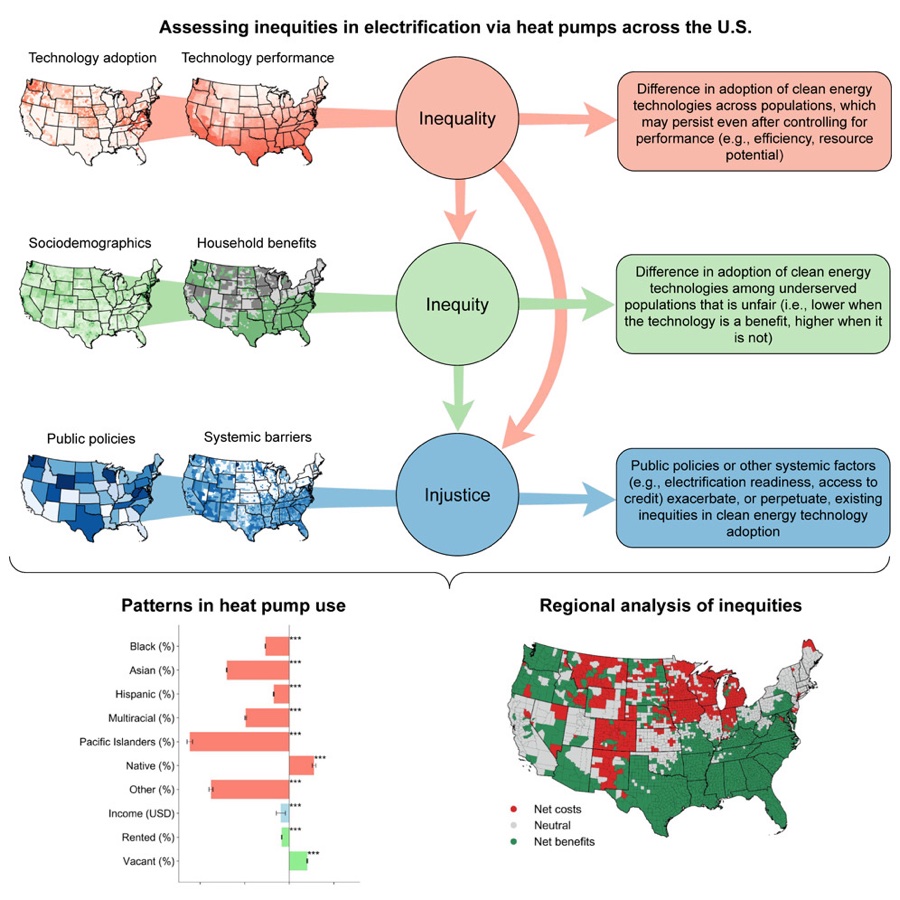
Assessing inequities in electrification via heat pumps across the US
Abstract
Heat pumps are an energy-efficient and increasingly cost-effective solution for reducing greenhouse gas emissions in the building sector. However, other clean energy technologies, such as rooftop solar, are less likely to be adopted in underserved communities, and thus policies incentivizing their adoption may funnel support to well-resourced communities. Unlike previously studied technologies, the effects of heat pumps on household energy bills may be positive or negative depending on local climate, energy costs, building features, and other factors. Here, we propose a framework for assessing heat pump inequities across the US. We find that households in communities of color and with higher percentages of renters are less likely to use heat pumps across the board. Moreover, communities of color are least likely to use heat pumps in regions where they are most likely to reduce energy bills. Public policies must address these inequities to advance beneficial electrification and energy justice.
Working Papers
How the Public Defines Climate Security
Abstract
Under what conditions does the American public view climate change as a matter of national security, and what does that imply for climate policy attitudes? We treat securitization as a measurable public perception with the potential to affect policy support. We further theorize that securitization is more successful in the aftermath of major climate shocks that make climate impacts feel more urgent and proximal, heighten threat-related emotions, and raise perceived risk — conditions that also increase receptivity to elite security framing. We field two preregistered studies. Study 1, fielded in 2025, develops and validates a securitization index capturing whether respondents see an issue as implicating sovereignty, international power, military responsibility, and direct security threats. Study 2, planned for 2026, combines experimental survey methods with granular geospatial data on wildfire risk and exposure. Using a rolling design during peak wildfire season, we sample adults in high-risk areas and leverage quasi-random variation in wildfire timing to compare respondents who experience an actual wildfire to respondents in the same general area who do not. We test whether wildfire exposure and elite security framing increase securitization, and we explore how securitization relates to pro-climate attitudes and support for climate mitigation and adaptation policies.
Un-bundling the psychological distance of climate change: Effects on policy attitudes depend on design
Abstract
Climate change is commonly cited as a collective action challenge because people generally feel it is a distant issue in many respects. However, empirical evidence has shown making climate change feel psychologically close sometimes has no effect on, or can even reduce pro-climate attitudes. We argue these mixed findings may be partly driven by confounding variables. We re-examine this question with two preregistered conjoint experiments that simultaneously manipulate the spatial, temporal, probabilistic, and social distance of climate change as well as its perceived risk. Using two quota-matched samples of American adults, one Republican-only (Study 1; N=700) and another bipartisan (Study 2; N=1,777), we find that reducing psychological distance (PD) in each of the four dimensions generally increases support for climate change mitigation and adaptation policies, independent of perceived risk. Spatial distance, a focal PD dimension in prior work, has no significant effect on mitigation support. Manipulation checks support that our design worked as intended. These findings contribute by clarifying the causal effects of PD dimensions on pro-climate attitudes.
Observational Equivalence of LLM and Human Annotation
Abstract
In this paper, we show that LLM and human coding are observationally equivalent in terms of annotation quality: recent LLMs agree with expert coders at rates comparable to those observed among experts. We demonstrate this through replications of text-classification tasks from 14 peer-reviewed political science studies, in which ten LLMs, three human experts, and 165 crowdsourced workers independently classify the same texts using identical codebooks. We find that this equivalence is driven by ambiguity in the texts and coding rules. When LLMs disagree with experts, experts are also more likely to disagree with one another, and clarifying coding rules reduces disagreement among both experts and recent LLMs. Thus, there is little empirical basis for preferring human coding on the basis of annotation quality alone, while LLMs offer substantial advantages in speed and cost. We therefore argue that the central challenge of text annotation is no longer choosing between human and machine coders, but developing coding rules that minimize ambiguity and accounting for the ambiguity that remains. To this end, we propose using disagreement across LLMs to identify difficult cases and refine codebooks, and we develop ambiguity-aware bounds for downstream inference when a unique annotation cannot be defined for every text.
Works in Progress
Carbon Adjusted: Global South Firms' Perceptions of Carbon Pricing and Trade-Based Decarbonization
Common but Differentiated Justice? How COP Delegates Perceive Justice and Cooperation
Just Phaseout: How International Climate Finance Drives Indonesia's Energy Transition
Paris Agreement Polarizes U.S. Local Policymakers on Climate Action